
Building the Rural Health Workforce

Updated: 5 hours ago
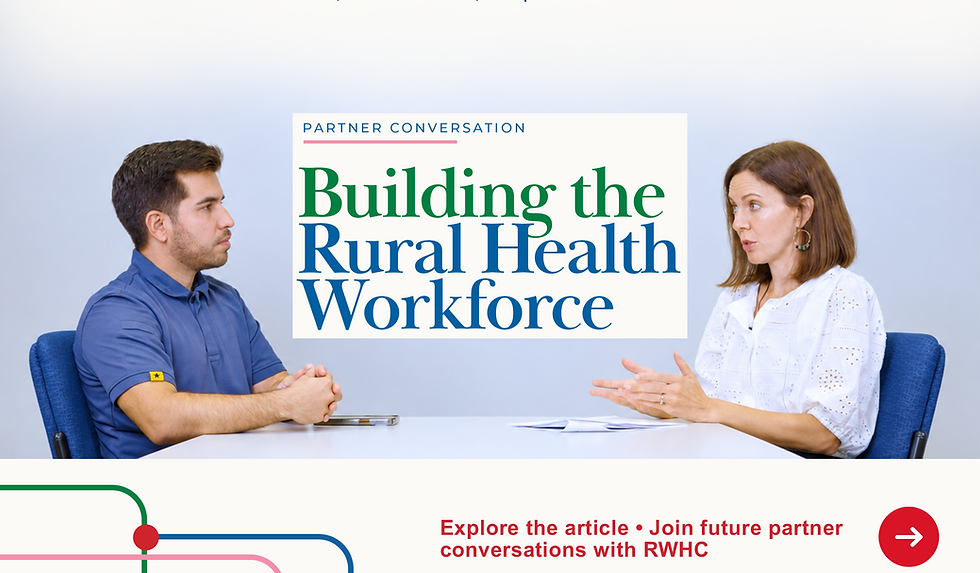
A conversation with Laura Rosen, Healthcare Partnerships Manager with Workforce Solutions Rural Capital Area, about training access, student challenges, clinical placements, and what it will take to grow healthcare talent closer to home.
There is a point early in our conversation with Laura Rosen when the rural healthcare workforce problem begins to sound almost contradictory.
Prefer to watch the full conversation? Go directly to the video.
People want to work in healthcare. Employers need workers. The industry is growing. So why can it still be so difficult to connect one to the other?
Rosen, came to the table with data, but also with something more useful: a view of where the pathway begins to break down for students and employers.
What started as a conversation about job shortages quickly became a conversation about distance, training, childcare, clinical placements, and whether rural communities can do a better job of growing talent closer to home.
The demand is there
The numbers make the opportunity hard to ignore. The Central Texas Healthcare Workforce Needs and Education Pipeline Study, developed by Workforce Solutions Rural Capital Area with Workforce Solutions Capital Area and Opportunity Austin, found that Central Texas added 24,837 healthcare jobs between 2019 and 2025. Another 14,178 new healthcare jobs are projected between 2026 and 2031 across the 10-county study region. [1][2]
But growth alone does not create a workforce. In rural communities, Rosen explained, the challenge often begins with geography. Someone may be interested in nursing, medical assisting, imaging, or another healthcare career, yet the training they need may not be available close to home.
The regional study reinforces that concern. It found that Caldwell and Lee counties currently have no identified postsecondary healthcare training providers, along with Blanco and Llano counties. The report points to expanding training closer to where people live and work as a clear opportunity for the region. [2]
That is where a career opportunity can become a transportation problem, a childcare problem, or simply a matter of too many miles.
A bottleneck hiding behind the classroom
One of the most interesting parts of our conversation was not about recruitment at all. It was about clinical placements.
Healthcare programs can have interested, qualified students and still struggle to expand because those students need somewhere to complete supervised clinical training.
Rosen described clinical placements as one of the most important pieces of the puzzle. The regional workforce study reaches a similar conclusion, recommending that Central Texas increase clinical placements, strengthen pathways from entry-level healthcare roles into nursing, and expand apprenticeships and other earn-and-learn models. [2]
Hospitals are an important part of that equation, but they are not the only possibility. Skilled nursing facilities, clinics, public health departments, and other healthcare organizations may also be able to help train students.
“You’re basically training your next employee.”
That was how I summarized the opportunity during the interview. Laura agreed. A clinical placement gives a student experience, but it can also give an employer time to know that person, mentor them, and show them what it might look like to build a career there. [3]
The barrier may not be academic
We also spent time talking about what happens outside the classroom. A student can be capable of completing a healthcare program and still be derailed by the realities around it.
A car problem matters when class is an hour away. Childcare matters when clinical hours do not match a parent’s schedule. Prerequisites, entrance exams, and the cost of simply staying in school all matter.
Rosen pointed to programs that take a more complete approach, helping students not only pay for training but navigate the journey through coaching, transportation assistance, and other support. [3]
That part of the conversation stayed with me because it changes how we think about workforce development. Sometimes the question is not, “Can this person become a nurse?” The better question may be, “What is standing between this person and becoming one?”
Who are we still missing?
Near the end of the interview, I asked Laura who needs to be part of these conversations moving forward.
Her answer was clear: employers.
If a hospital cannot find nurses, we need to hear why. If a skilled nursing facility needs nursing assistants, we need that experience at the table. If a clinic cannot find medical assistants, or a dental practice needs hygienists or assistants, those challenges should help shape what training and workforce partners work on next.
Rosen also stressed the importance of educational institutions and community partners. The Rural Whole Health Coalition’s Workforce Committee is designed around that mix: employers identifying the need, training providers helping build the pathway, and community partners helping address the barriers that can keep people from completing it. [3]
That is really the larger purpose of this conversation. We did not solve the rural healthcare workforce problem in thirty minutes. But we began connecting pieces that are too often discussed separately: jobs and education, training and transportation, students and employers, clinical placements and recruitment.
The more those pieces connect, the more possible it becomes to build healthcare careers locally and strengthen access to care at the same time.
Listen to the full conversation
There is much more in our discussion with Laura Rosen than we could capture here, including apprenticeships, student supports, employer recruitment, regional workforce projections, and the opportunities she believes rural communities can act on now.
We invite you to watch the full Partner Conversation and hear it directly from Laura.
Then stay in the conversation. Follow the Rural Whole Health Coalition on LinkedIn and Facebook for upcoming Partner Conversations, regional resources, events, and opportunities to participate.
If you represent a healthcare provider, employer, educational institution, workforce organization, nonprofit, public agency, or community group, we also invite you to join the RWHC network of partners. Tell us what you are seeing. Tell us what is not working. Bring the idea you think deserves a closer look.
Finding solutions to rural health challenges often starts in a remarkably simple place: getting the right people around the same table.
Watch the Full Partner Conversation
Hear more from Laura Rosen about healthcare workforce demand, access to training, clinical placements, student support and the opportunities rural communities can act on now.
References and source notes
[1] Workforce Solutions Rural Capital Area. “Central Texas Healthcare Workforce Needs and Education Pipeline Study.” August 14, 2026. View source
[2] Workforce Solutions Rural Capital Area. “New Study Provides Roadmap for Central Texas Healthcare Workforce Growth.” August 24, 2026. View source
[3] Rural Whole Health Coalition. Partner Conversation with Laura Rosen, Healthcare Partnerships Manager, Workforce Solutions Rural Capital Area. Interview transcript, September 2026. Primary source for quotations, discussion themes, and statements attributed to Rosen. Numerical workforce data cited in the article comes from sources [1] and [2].


Comments